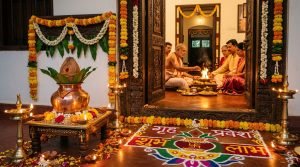
✦ Quick Answer: What are the Best Hindu Marriage (Vivah) Muhurats in 2027?
In 2027, the primary wedding seasons are divided into three high-demand astrological windows: Late Winter (Jan 17 – Feb 26), Spring/Early Summer (Apr 18 – Jun 24), and Late Autumn/Early Winter (Nov 19 – Dec 10). Peak wedding demand falls in May 2027, with Akshaya Tritiya on May 9, 2027 acting as a self-effulgent Abujha Muhurat.
Crucial Astrological Bans: Marriages are strictly halted during Chaturmas (July 14, 2027 to November 10, 2027) when Lord Vishnu enters celestial slumber, during Shukra Asta / Venus Combustion (July 6 to August 13, 2027), and during the two Kharmas/Malmas periods (Sun in Pisces: mid-March to mid-April; Sun in Sagittarius: mid-December to mid-January).
Vivaha Samskara is revered in Vedic tradition not merely as a social union, but as a sacred celestial covenant bonding two souls across lifetimes (Saptapadi). According to foundational texts such as the Muhurtha Chintamani, Brihat Samhita, and Jyotirvidabharana, the planetary configuration at the exact moment of tying the sacred knot (Mangalyadharana) determines longevity, marital affection, financial stability, and dharmic offspring.
Core Principles of Vivaha Lagna Shuddhi (Astrological Purification)
A valid Vedic wedding date requires far more than matching birth charts (Kundali Milan). The electional chart (Muhurtham Lagna) must fulfill four cardinal requirements:
- 1. Guru Bal (Jupiter’s Strength for the Bride): Jupiter is the karaka (significator) of the husband and progeny in a woman’s chart. Jupiter must transit a favorable house (2nd, 5th, 7th, 9th, or 11th from the bride’s Janma Rashi) or be fortified by Navamsha alignment.
- 2. Surya Bal (Sun’s Strength for the Groom): The Sun governs vitality, fatherhood, and dharmic duty. The transiting Sun must be auspicious (3rd, 6th, 10th, or 11th from the groom’s natal Moon).
- 3. Chandra Bal (Moon’s Purity for Both): On the marriage day, the Moon must not occupy the 6th, 8th, or 12th houses from either partner’s natal Moon sign (Ashtama Chandra is strictly forbidden).
- 4. Saptama Shuddhi (Empty 7th House): The 7th house in the elected Muhurtham ascendant must be entirely devoid of any celestial bodies—especially malefic planets like Mars, Saturn, Rahu, or Ketu.
Calculate location-specific Vivaha Lagnams, Shubh Choghadiya, and Rahu Kalam timings for your specific city on PujaPanchang.
Strict Inauspicious Periods in 2027: When Weddings are Prohibited
Before reserving wedding banquet halls or booking purohits, eliminate these scripturally barred periods:
Month-by-Month Hindu Marriage Muhurat Calendar 2027
Below are the certified auspicious marriage dates for 2027 calculated in accordance with Shukla Paksha and favorable Krishna Paksha tithis, primary Vivaha Nakshatras (Rohini, Mrigashirsha, Magha, Uttara Phalguni, Hasta, Swati, Anuradha, Moola, Uttarashadha, Uttara Bhadrapada, Revati):
Sacred Rites of Vedic Vivaha: Step-by-Step Significance
- 1. Kanyadan & Hastamelap: The bride’s father offers her hand to the groom, invoking Lord Vishnu as witness. The sacred yellow cloth ties the groom’s scarf to the bride’s pallu (Granthi Bandhanam), representing the intertwining of their karmic paths.
- 2. Vivaha Homa (Sacred Fire Invocations): The consecrated fire (Agni Deva) acts as the divine witness. Oblations of ghee, samidha, and puffed rice (Laja Homa) are offered while chanting Vedic wedding hymns.
- 3. Mangalyadharana: The sacred necklace or thread (Mangalsutra / Tali) adorned with turmeric and auspicious gold motifs is tied around the bride’s neck with three knots—signifying devotion to husband, respect to families, and commitment to dharma.
- 4. Saptapadi (The Seven Sacred Steps): Walking seven steps together around the Agni altar, taking sacred vows for nourishment, strength, prosperity, happiness, progeny, seasonal harmony, and eternal spiritual friendship.
- 5. Arundhati & Dhruva Darshanam: The newly wedded couple observes the steady North Star (Dhruva) for steadfastness and the double star of sage Vashistha and his chaste wife Arundhati for unwavering marital devotion.
Frequently Asked Questions (FAQ) on 2027 Marriage Muhurats
Q1: What happens if a marriage is performed during Shukra Asta (Venus Combustion)?
In Vedic astrology, Venus governs love, conjugal harmony, beauty, and domestic prosperity. When Venus is combust (too close to the Sun), its auspicious energy is dormant. Classical authorities explicitly state that marriages solemnized during Shukra Asta suffer from lack of mutual affection, unnecessary friction, and domestic stress.
Q2: Is Akshaya Tritiya 2027 auspicious for all zodiac signs without horoscope matching?
Akshaya Tritiya (May 9, 2027) is an Abujha Muhurat—a celestial day so inherently luminous that basic date selection requires no special remediation. However, personal Kundali Milan and ensuring that the day does not coincide with either partner’s natal Janma Nakshatra is still highly advised by learned astrologers.
Q3: Why must the 7th house be empty during the wedding Lagnam?
The 7th house in the electional chart directly represents the spouse and marital bliss (Kalatra Sthana). The presence of malefic planets (Mars, Saturn, Sun, Rahu, Ketu) damages marital longevity or causes conflict. Even beneficial planets are usually preferred in the 1st, 4th, 5th, 9th, or 10th houses rather than directly in the 7th house during marriage.