The Pancha Angas (literally “Five Limbs” in Sanskrit) are the five fundamental astronomical coordinates that constitute a Vedic calendar or Hindu Panchangam: Tithi (Lunar Day, angular separation of 12° between Moon and Sun), Vara (Solar Weekday, based on sunrise-to-sunrise diurnal cycle), Nakshatra (Lunar Mansion, 27 asterisms of 13°20′ each), Yoga (Angular Sum of Sun and Moon longitudes), and Karana (Half of a Tithi, spanning 6°). Together, they capture the subtle gravitational, electromagnetic, and temporal energies of the cosmos to determine the auspiciousness (Shubh Muhurtham) of any given moment.
The Cosmic Architecture of Vedic Time
Unlike standard Gregorian timekeeping—which relies solely on the Earth’s orbit around the Sun divided into mechanical 24-hour clock cycles—Vedic chronometry operates on an interactive astronomical matrix. As codified in classical treatises like the Surya Siddhanta and Vedanga Jyotisha, time is not static; it possesses qualitative energetic attributes known as Kala Shakti.
The human bio-energetic system, planetary movements, and terrestrial rhythms are in constant resonance. By tracking the exact angular positions of Surya (the Sun, representing the soul and vitality) and Chandra (the Moon, representing the mind and emotions), the Panchangam provides precise guidance for personal sadhana, religious observances, and worldly undertakings.
The Five Limbs: Astronomical Basis and Elemental Governance
In the Shastras, each of the five limbs is intrinsically linked to one of the Pancha Maha Bhootas (the five primordial cosmic elements):
1. Tithi (Water Element — Jala Tattva)
A Tithi is defined as the time taken by the Moon to increase its longitudinal distance from the Sun by exactly 12 degrees. A complete synodic lunar month contains 360 degrees, comprising 30 Tithis:
- Shukla Paksha (Waxing Phase): 15 Tithis from Pratipada to Purnima (Full Moon).
- Krishna Paksha (Waning Phase): 15 Tithis from Pratipada to Amavasya (New Moon).
Because the Moon moves in an elliptical orbit at variable orbital speeds (faster at perigee, slower at apogee), a Tithi does not match a standard 24-hour clock day. A Tithi can vary in duration between approximately 19 to 26 hours. In Vedic philosophy, Tithi governs the water element and rules emotional well-being, reproductive vitality, and spiritual receptivity.
2. Vara (Fire Element — Agni Tattva)
Vara is the solar weekday. In the Vedic system, a day begins precisely at local astronomical sunrise (Surya Udaya) and terminates at the subsequent sunrise—a complete diurnal cycle known as an Ahoratra. The seven Varas are ruled by the seven classical planets:
- Ravivara (Sunday): Surya (Vitality, spiritual authority)
- Somavara (Monday): Chandra (Calmness, motherly grace)
- Mangalavara (Tuesday): Mangala (Courage, physical vitality)
- Budhavara (Wednesday): Budha (Intellect, commerce, communication)
- Guruvara (Thursday): Brihaspati (Wisdom, learning, dharma)
- Shukravara (Friday): Shukra (Art, prosperity, relationship harmony)
- Shanivara (Saturday): Shani (Discipline, perseverance, longevity)
Vara governs the fire element (Agni) and directly dictates physical stamina, longevity (Ayush), and metabolism.
3. Nakshatra (Air Element — Vayu Tattva)
The ecliptic (360°) is divided into 27 equal stellar divisions called Nakshatras, each spanning 13 degrees and 20 minutes (13°20′). As the Moon orbits the Earth against the backdrop of the fixed stars, it traverses approximately one Nakshatra every 24 hours.
Each Nakshatra is further subdivided into four Padas (quarters) of 3°20′ each, creating 108 Padas that form the foundation of Vedic birth charts (Janma Kundali). Nakshatras represent the air element, governing mental tendencies, subconscious impressions (Samskaras), and personal temperament.
4. Yoga (Ether Element — Akasha Tattva)
A Yoga is calculated by adding the celestial longitude of the Sun and the Moon and dividing the sum into 27 equal segments of 13°20′ each:
Yoga = (Longitude of Sun + Longitude of Moon) mod 360° / 13°20'
There are 27 Yogas, beginning with Vishkambha and concluding with Vaidhriti. Certain Yogas (such as Siddhi, Shubha, and Shiva) impart extraordinary auspiciousness, whereas others (such as Vyatipata and Vaidhriti) are reserved strictly for introspection and japa. Yoga represents the ether element (Akasha) and governs harmony, relationship alignment, and holistic unity.
5. Karana (Earth Element — Prithvi Tattva)
A Karana is exactly half of a Tithi, representing a 6-degree separation between the Sun and the Moon. There are 60 Karanas in a single lunar month. They are classified into two groups:
- 7 Movable Karanas (Chara): Bava, Balava, Kaulava, Taitila, Garija, Vanija, and Vishti (also known as Bhadra, requiring caution). These rotate eight times through the month.
- 4 Fixed Karanas (Sthira): Shakuni, Chatushpada, Naga, and Kimstughna. These occur only once per lunar month around Amavasya.
Karana corresponds to the earth element (Prithvi) and governs material execution, tangible results, and productive work (Karya Siddhi).
Pancha Angas Comparative Reference Matrix
| Anga (Limb) | Astronomical Calculation | Ruling Element | Governing Aspect | Divisions |
|---|---|---|---|---|
| Tithi | (Moon Longitude – Sun Longitude) / 12° | Water (Jala) | Emotional health, relationships | 30 per lunar month |
| Vara | Sunrise to subsequent sunrise | Fire (Agni) | Physical vitality, lifespan (Ayush) | 7 solar days |
| Nakshatra | Moon’s ecliptic position / 13°20′ | Air (Vayu) | Subconscious temperament, destiny | 27 stellar mansions |
| Yoga | (Sun Longitude + Moon Longitude) / 13°20′ | Ether (Akasha) | Holistic harmony, energetic balance | 27 yogas |
| Karana | Half of a Tithi (6° separation) | Earth (Prithvi) | Tangible action, success (Karya Siddhi) | 60 per month (11 types) |
Practical Application in Daily Life & Muhurtham
Consulting the Panchangam is not merely for astrologers; it is an everyday spiritual discipline for aligning one’s actions with cosmic currents:
- Daily Sadhana: Reciting daily morning prayers (Surya Puja Vidhi) during sunrise activates the positive solar vibration of the day’s Vara.
- Avoiding Inauspicious Intervals: Calculating daytime segments helps avoid periods ruled by malefic nodes, such as Rahu Kalam and Gulika Kalam.
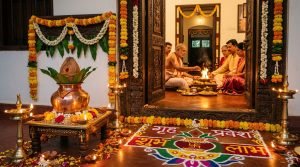
- Life Milestones: Selecting an auspicious wedding or Griha Pravesh date requires examining all five limbs simultaneously to ensure harmony between the bride, groom, and planetary alignments via Shubh Muhurtham Finder.
Frequently Asked Questions
What does Panchangam literally mean?
The Sanskrit word Panchangam is derived from Pancha (meaning five) and Anga (meaning limbs or attributes). It refers to the five astronomical components—Tithi, Vara, Nakshatra, Yoga, and Karana—that define the cosmic state of any given day.
Why do Tithi end times vary between different cities?
While the physical Sun-Moon angular separation occurs globally at the same universal instant, a Tithi’s association with a specific day depends on local sunrise (Udaya Tithi). Because sunrise times vary across latitudes and longitudes, astronomical Panchangams calculate exact local timings for each city.
Which of the five limbs governs physical lifespan and health?
Vara (the solar weekday) governs the fire element (Agni) and represents vitality, health, and physical longevity (Ayush). In Vedic texts, honoring the deity of the day enhances personal life force.
Can an auspicious Muhurtham occur during an inauspicious Yoga?
Generally, classical Muhurtha Shastras advise avoiding inauspicious Yogas like Vyatipata or Vaidhriti for major celebrations. However, exceptional strengths in Tithi, Lagna, or planetary placements can sometimes neutralize minor afflictions for routine activities.
{
“@context”: “https://schema.org”,
“@type”: “FAQPage”,
“mainEntity”: [
{
“@type”: “Question”,
“name”: “What does Panchangam literally mean?”,
“acceptedAnswer”: {
“@type”: “Answer”,
“text”: “The Sanskrit word Panchangam is derived from Pancha (meaning five) and Anga (meaning limbs or attributes). It refers to the five astronomical components—Tithi, Vara, Nakshatra, Yoga, and Karana—that define the cosmic state of any given day.”
}
},
{
“@type”: “Question”,
“name”: “Why do Tithi end times vary between different cities?”,
“acceptedAnswer”: {
“@type”: “Answer”,
“text”: “While the physical Sun-Moon angular separation occurs globally at the same universal instant, a Tithi’s association with a specific day depends on local sunrise (Udaya Tithi). Because sunrise times vary across latitudes and longitudes, astronomical Panchangams calculate exact local timings for each city.”
}
},
{
“@type”: “Question”,
“name”: “Which of the five limbs governs physical lifespan and health?”,
“acceptedAnswer”: {
“@type”: “Answer”,
“text”: “Vara (the solar weekday) governs the fire element (Agni) and represents vitality, health, and physical longevity (Ayush). In Vedic texts, honoring the deity of the day enhances personal life force.”
}
},
{
“@type”: “Question”,
“name”: “Can an auspicious Muhurtham occur during an inauspicious Yoga?”,
“acceptedAnswer”: {
“@type”: “Answer”,
“text”: “Generally, classical Muhurtha Shastras advise avoiding inauspicious Yogas like Vyatipata or Vaidhriti for major celebrations. However, exceptional strengths in Tithi, Lagna, or planetary placements can sometimes neutralize minor afflictions for routine activities.”
}
}
]
}