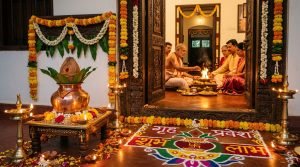
In Vedic timekeeping (as defined in Surya Siddhanta and Muhurtha Chintamani), the daytime duration between exact local sunrise and sunset is divided into eight equal parts called Ashtamamsha. Specific segments are assigned to subtle shadow entities (Chhaya Grahas): Rahu Kalam is the 90-minute segment ruled by Rahu (the ascending lunar node), representing chaotic material energy during which starting new auspicious journeys, financial contracts, or Griha Pravesh is avoided. Gulika Kalam (ruled by Gulika or Mandi, son of Saturn) and Yamagandam (ruled by Yama, god of cosmic law) represent specific periods with distinct ritual applications.
Astronomical Division: The Ashtamamsha Principle
A widespread misconception in modern society is that Rahu Kalam occurs at static wall-clock times (e.g., assuming 4:30 PM to 6:00 PM on Sundays). In authentic Vedic astronomy, clock times are purely approximations.
The true Vedic formula calculates the day interval from local astronomical sunrise (Surya Udaya) to local astronomical sunset (Surya Astama). This entire span is divided into eight equal segments (each approximately 1 hour and 30 minutes on an equinox, but varying between 1 hour 15 minutes to 1 hour 45 minutes depending on geographic latitude and the solar season):
Daytime Duration = (Local Sunset - Local Sunrise) / 8
To verify the exact micro-timings for your specific geographic location today, consult our live Daily Panchangam Engine.
Weekday Master Schedule for Rahu, Gulika & Yamagandam
Each day of the week assigns the eight daytime segments in a fixed order. The first eighth of every day is ruled by the lord of that day, while the remaining segments belong to other planetary entities:
| Weekday | Day Lord | Rahu Kalam (Part) | Gulika Kalam (Part) | Yamagandam (Part) | Approx. Clock Time (Standard 6AM-6PM) |
|---|---|---|---|---|---|
| Sunday (Ravivara) | Surya | 8th Part | 7th Part | 5th Part | 04:30 PM – 06:00 PM |
| Monday (Somavara) | Chandra | 2nd Part | 6th Part | 4th Part | 07:30 AM – 09:00 AM |
| Tuesday (Mangalavara) | Mangala | 7th Part | 5th Part | 3rd Part | 03:00 PM – 04:30 PM |
| Wednesday (Budhavara) | Budha | 5th Part | 4th Part | 2nd Part | 12:00 PM – 01:30 PM |
| Thursday (Guruvara) | Brihaspati | 6th Part | 3rd Part | 1st Part | 01:30 PM – 03:00 PM |
| Friday (Shukravara) | Shukra | 4th Part | 2nd Part | 7th Part | 10:30 AM – 12:00 PM |
| Saturday (Shanivara) | Shani | 3rd Part | 1st Part | 6th Part | 09:00 AM – 10:30 AM |
Traditional Scholar Mnemonic for Rahu Kalam: An age-old Sanskrit mnemonical sequence remembers the order of parts: Monday (2), Saturday (3), Friday (4), Wednesday (5), Thursday (6), Tuesday (7), Sunday (8).
The Spiritual & Psychological Meaning of the Shadow Grahas
1. Rahu: The Cosmic Disruptor
Astronomically, Rahu is not a physical planetary mass; it is the northern ascending intersection point (node) of the Moon’s orbital path with the ecliptic. Because eclipses occur at these nodes, Rahu signifies obscuration of solar radiance and lunar clarity. Starting major new worldly undertakings during Rahu Kalam often encounters unforeseen hurdles, bureaucratic stalls, or mental illusions.
2. Gulika (Mandi): The Son of Saturn
Gulika is a mathematical point representing Saturn’s sub-planet. In South Indian astrology (particularly in Kerala and Tamil Nadu), Gulika Kalam is viewed with great nuance. While generally avoided for celebratory rites like weddings, actions commenced during Gulika Kalam often repeat or take a long time to conclude—making it traditionally suitable for building permanent foundations or long-term storage.
3. Yamagandam: The Lord of Cosmic Dharma
Ruled by Yama, Yamagandam signifies the potential for termination or severe disruption. Starting travels or critical financial investments during Yamagandam is strictly avoided in traditional Muhurtham selection.
The Great Exception: Rahu Kalam Durga Worship
While materialistic beginnings are restricted during Rahu Kalam, an extraordinary Shastric exception exists for worshiping Divine Mother Durga. Because Goddess Durga is the supreme vanquisher of demonic forces and the controller of Rahu’s malefic effects, lighting a lemon lamp (Nimbu Deepam) to Goddess Durga on Tuesday or Friday during Rahu Kalam is revered across South India for removing obstacles and nullifying Sarpa Doshas. Review our complete Durga Puja Vidhi for traditional procedures.
Frequently Asked Questions
Can regular prayer or temple visits be done during Rahu Kalam?
Yes. Routine daily prayers, ongoing mantra japa, temple visits, and especially Goddess Durga worship are entirely permitted and highly auspicious during Rahu Kalam. Only initiating brand new worldly ventures (such as signing contracts, buying property, or starting long journeys) is avoided.
Does Rahu Kalam apply to the night hours?
Classical Panchangams define Rahu Kalam primarily for daytime hours (sunrise to sunset). While theoretical nocturnal divisions (Ratri Rahu Kalam) exist in certain specialized Kerala astrological texts, standard everyday Muhurtham practices only apply daytime Rahu Kalam.
Why is Rahu Kalam different in summer and winter?
Because Rahu Kalam is calculated as one-eighth of the total daytime interval between sunrise and sunset, seasonal variations in day length cause Rahu Kalam’s duration to expand in summer (longer days) and contract in winter (shorter days).
How does Rahu Kalam relate to the Pancha Angas?
While Rahu Kalam is a diurnal planetary division rather than one of the core five limbs, it directly modulates the efficacy of the day’s Vara and Muhurtham. To understand the foundational pillars of Vedic time, see our guide on the Pancha Angas of Vedic Time.
{
“@context”: “https://schema.org”,
“@type”: “FAQPage”,
“mainEntity”: [
{
“@type”: “Question”,
“name”: “Can regular prayer or temple visits be done during Rahu Kalam?”,
“acceptedAnswer”: {
“@type”: “Answer”,
“text”: “Yes. Routine daily prayers, ongoing mantra japa, temple visits, and especially Goddess Durga worship are entirely permitted and highly auspicious during Rahu Kalam. Only initiating brand new worldly ventures (such as signing contracts, buying property, or starting long journeys) is avoided.”
}
},
{
“@type”: “Question”,
“name”: “Does Rahu Kalam apply to the night hours?”,
“acceptedAnswer”: {
“@type”: “Answer”,
“text”: “Classical Panchangams define Rahu Kalam primarily for daytime hours (sunrise to sunset). While theoretical nocturnal divisions (Ratri Rahu Kalam) exist in certain specialized Kerala astrological texts, standard everyday Muhurtham practices only apply daytime Rahu Kalam.”
}
},
{
“@type”: “Question”,
“name”: “Why is Rahu Kalam different in summer and winter?”,
“acceptedAnswer”: {
“@type”: “Answer”,
“text”: “Because Rahu Kalam is calculated as one-eighth of the total daytime interval between sunrise and sunset, seasonal variations in day length cause Rahu Kalam’s duration to expand in summer (longer days) and contract in winter (shorter days).”
}
},
{
“@type”: “Question”,
“name”: “How does Rahu Kalam relate to the Pancha Angas?”,
“acceptedAnswer”: {
“@type”: “Answer”,
“text”: “While Rahu Kalam is a diurnal planetary division rather than one of the core five limbs, it directly modulates the efficacy of the day’s Vara and Muhurtham. To understand the foundational pillars of Vedic time, see our guide on the Pancha Angas of Vedic Time.”
}
}
]
}