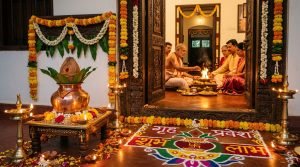
Sanatana Dharma (often translated as the “Eternal Cosmic Order” or “Universal Natural Law”) is the timeless spiritual and philosophical heritage of Vedic civilization. Rather than being a dogmatic religion founded by a single historical prophet, Sanatana Dharma is an organic, multi-dimensional way of life rooted in the eternal truths (Apaurusheya) revealed in the Vedas. It guides individuals toward universal harmony through four foundational pursuits of life (Purusharthas): Dharma (righteous living), Artha (noble wealth), Kama (fulfilled desire), and Moksha (spiritual liberation).
Etymology & Philosophy: The Nature of the Eternal Law
The term Sanatana means that which has neither beginning (Anadi) nor end (Ananta)—that which is timeless, self-existent, and perpetually renewed. The word Dharma originates from the Sanskrit root dhri, signifying “that which upholds, sustains, and holds together”.
Just as the law of gravity governs physical bodies without regard to faith or nationality, Sanatana Dharma encompasses the immutable cosmic principles (Rta) that govern consciousness, karma, morality, and biological evolution. It recognizes the fundamental non-dual reality: Ekam Sat Vipra Bahudha Vadanti—Truth is One, though the wise articulate It in diverse ways.
The Four Purusharthas: The Balanced Framework of Human Existence
Unlike belief systems that demand severe world-denial or promote unrestrained consumerism, Vedic wisdom provides a holistic architectural framework for a purposeful human life:
| Purushartha | Primary Meaning | Scope of Action | Spiritual Role |
|---|---|---|---|
| 1. Dharma | Righteousness, duty, moral ethics | Upholding truth, compassion, non-harming (Ahimsa) | The ethical foundation that anchors all desires |
| 2. Artha | Material security, prosperity, career | Earning ethical wealth to sustain family and society | Enables charity, yajnas, and societal well-being |
| 3. Kama | Fulfillment of desire, aesthetic love | Appreciation of arts, music, beauty, and family joy | Cultivates emotional fulfillment within dharmic boundaries |
| 4. Moksha | Ultimate spiritual liberation | Self-realization, overcoming the cycle of Samsara | The supreme destination of human consciousness |
The Law of Karma and Reincarnation (Samsara)
A central pillar of Sanatana Dharma is the cosmic law of causality known as Karma. Every intentional action (physical, verbal, or mental) imprints a subtle seed (Samskara) upon consciousness that ripens as future experience:
- Sanchita Karma: The vast accumulation of past karmas stored across multiple lifetimes.
- Prarabdha Karma: The specific portion of past karma that has crystallized to form one’s present birth, physical body, temperament, and life circumstances.
- Agami (Kriyamana) Karma: The new actions and conscious choices being generated in the present moment through free will.
Practical Daily Living: The Pancha Maha Yajnas
Sanatana Dharma is lived through daily practice rather than theoretical belief. Householders are encouraged to perform the five daily offerings (Pancha Maha Yajnas) to live in harmony with the cosmos:
- Brahma Yajna (Rishi Yajna): Honoring the ancient seers through daily reading of scriptures, contemplation, and learning.
- Deva Yajna: Honoring cosmic forces through lighting the sacred oil lamp, performing sandhyavandanam, and practicing morning devotion (Surya Puja Vidhi).
- Pitri Yajna: Honoring one’s ancestors through daily remembrance, tarpanam, and offering gratitude for one’s physical lineage.
- Manushya Yajna: Honoring humanity through hospitality (Atithi Devo Bhava), acts of charity, and selfless community service.
- Bhuta Yajna: Honoring nature, plants, cows, birds, and animals by providing food and living ecologically.
Aligning Daily Life with Cosmic Cycles
To implement Vedic principles, individuals align daily activities with natural cosmic rhythms:
- Tracking daily astronomical coordinates through our Daily Panchangam to harmonize with Tithi, Vara, Nakshatra, Yoga, and Karana (read our detailed guide on the Pancha Angas of Vedic Time).
- Timing important undertakings using authentic Shubh Muhurtham while avoiding inauspicious intervals like Rahu Kalam and Yamagandam.
- Visiting consecrated spiritual centers across our nationwide directory of Sacred Hindu Temples.
Frequently Asked Questions
Is Sanatana Dharma the same as Hinduism?
Yes. “Hinduism” is the modern geographical and historical term popularized by outsiders to describe the people living beyond the Sindhu (Indus) river, whereas Sanatana Dharma is the indigenous, classical Sanskrit name that describes the timeless spiritual system itself.
What are the primary authoritative scriptures of Sanatana Dharma?
The foundational texts are the Shrutis (divinely revealed eternal sounds: Rigveda, Yajurveda, Samaveda, and Atharvaveda, culminating in the Upanishads). These are supported by Smritis (remembered traditions, including the Bhagavad Gita, the Epics Ramayana and Mahabharata, and the Puranas).
Does Sanatana Dharma promote polytheism or monotheism?
Vedic philosophy is neither simple polytheism nor rigid monotheism; it is fundamentally Panentheistic and Non-Dual (Advaita). It recognizes one transcendent, omnipresent Supreme Consciousness (Brahman) that manifests through innumerable divine aspects, deities, and forms.
How does a beginner start practicing Sanatana Dharma daily?
A beginner can begin with simple daily routines: rising during Brahma Muhurtha, lighting a ghee or sesame oil lamp, chanting the Gayatri Mantra, offering fresh water to Surya, practicing Ahimsa (non-harming), and aligning tasks with the daily Panchangam.
{
“@context”: “https://schema.org”,
“@type”: “FAQPage”,
“mainEntity”: [
{
“@type”: “Question”,
“name”: “Is Sanatana Dharma the same as Hinduism?”,
“acceptedAnswer”: {
“@type”: “Answer”,
“text”: “Yes. ‘Hinduism’ is the modern geographical and historical term popularized by outsiders to describe the people living beyond the Sindhu (Indus) river, whereas Sanatana Dharma is the indigenous, classical Sanskrit name that describes the timeless spiritual system itself.”
}
},
{
“@type”: “Question”,
“name”: “What are the primary authoritative scriptures of Sanatana Dharma?”,
“acceptedAnswer”: {
“@type”: “Answer”,
“text”: “The foundational texts are the Shrutis (divinely revealed eternal sounds: Rigveda, Yajurveda, Samaveda, and Atharvaveda, culminating in the Upanishads). These are supported by Smritis (remembered traditions, including the Bhagavad Gita, the Epics Ramayana and Mahabharata, and the Puranas).”
}
},
{
“@type”: “Question”,
“name”: “Does Sanatana Dharma promote polytheism or monotheism?”,
“acceptedAnswer”: {
“@type”: “Answer”,
“text”: “Vedic philosophy is neither simple polytheism nor rigid monotheism; it is fundamentally Panentheistic and Non-Dual (Advaita). It recognizes one transcendent, omnipresent Supreme Consciousness (Brahman) that manifests through innumerable divine aspects, deities, and forms.”
}
},
{
“@type”: “Question”,
“name”: “How does a beginner start practicing Sanatana Dharma daily?”,
“acceptedAnswer”: {
“@type”: “Answer”,
“text”: “A beginner can begin with simple daily routines: rising during Brahma Muhurtha, lighting a ghee or sesame oil lamp, chanting the Gayatri Mantra, offering fresh water to Surya, practicing Ahimsa (non-harming), and aligning tasks with the daily Panchangam.”
}
}
]
}